The guardrails an AI operator needs before it touches your sending domain
Rate limits, approval gates, and evidence requirements for letting an AI agent run cold email campaigns — and the signals that should never be fully automated.
By Norbelys Chirinos, Co-founder
Founder-reviewed ·How we research and correct articles
Handing an AI agent your sending domain is a different kind of automation than handing it your calendar. A miscalibrated scheduling agent double-books a meeting. A miscalibrated sending agent can burn a domain’s reputation in a way that takes weeks to rebuild — sometimes longer than the original warmup did. The capability is genuinely useful. The guardrails around it are not optional extras; they’re the reason the capability is safe to grant at all.
Here’s what those guardrails should actually look like, and why each one earns its place.
Why capability and authority are different questions
An AI operator can, in principle, research a market, draft a sequence, and queue it against a segment faster than any human could. That’s a capability question, and the answer is mostly yes. Whether it should be allowed to do all of that and decide on its own that the campaign is ready to reach real inboxes is an authority question, and the answer should almost always be no — not because the agent is untrustworthy in the abstract, but because sending is the one action in the loop that isn’t reversible.
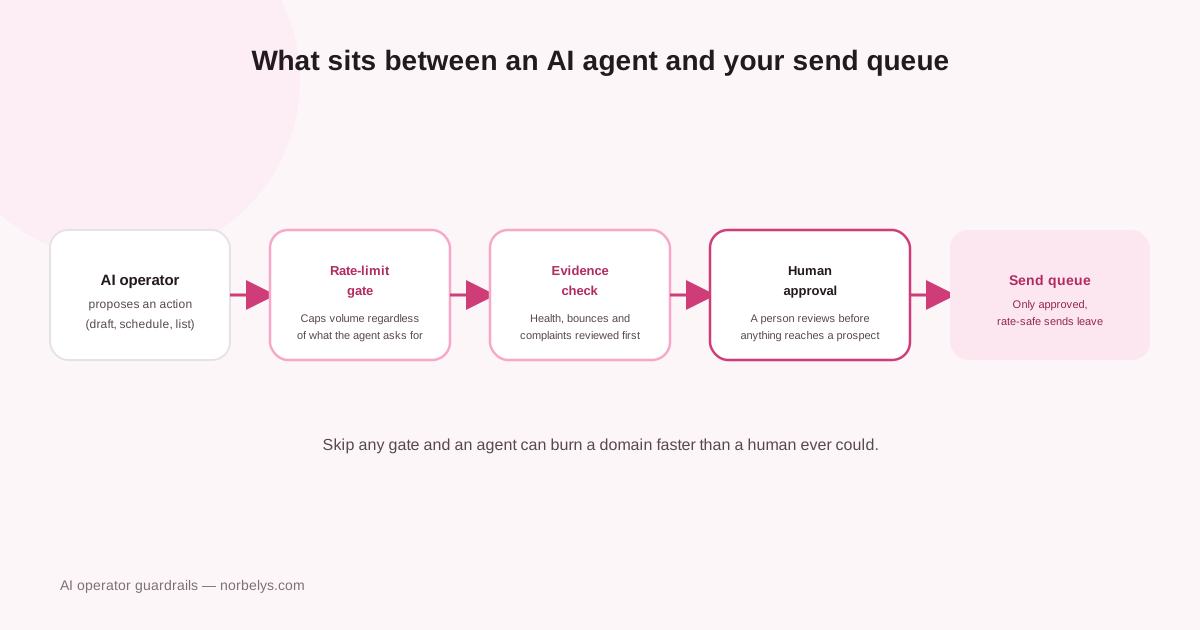
Every proposed action from the agent passes through the same checkpoints a human-built campaign would — capacity, evidence, and an explicit approval — before anything reaches the send queue.
Rate limits: the boring guardrail that matters most
The least glamorous guardrail is also the one that prevents the most damage: an agent should never be able to exceed the sending limits a healthy mailbox already has, no matter how confident it is that a campaign is ready. A mailbox’s daily capacity exists because of warmup state, provider trust, and recent history — not because of how many prospects an agent has queued up to contact. An agent that can talk its way past a rate limit (“just this once, the list is really good”) has already stopped being a guardrail.
This is why the rate limit has to live in the sending infrastructure itself, not in the agent’s instructions. An instruction is a suggestion the agent follows until it decides otherwise, or until a prompt manipulates it into deciding otherwise. A limit enforced at the platform level doesn’t have that failure mode — the agent can propose a thousand messages, but a healthy mailbox’s actual capacity determines what goes out today.
Human approval gates: what should always wait for a yes
Not every action needs a human in the loop. Research, drafting, staging a sequence, proposing an audience — an agent can do all of that unattended, and should, because none of it touches a real inbox. The gate belongs at the one point where that changes: launch.
A well-designed operator treats “contact someone new” as categorically different from every other action it can take, the way the AI operator is built to work — research and staging run freely, but a campaign is presented with its evidence for a human to approve before a single message goes out. The distinction isn’t about how much work the agent did beforehand. It’s about which action is reversible and which one isn’t.
The same principle extends past the first launch. An agent monitoring a live campaign overnight and slowing down a mailbox that’s showing early trouble is a reasonable standing instruction — that’s a protective action. An agent deciding on its own to resume a paused campaign, add a new segment, or extend a sequence to more recipients is not the same category of decision, and shouldn’t get the same unattended trust.
Evidence requirements: don’t let the agent invent trust
A guardrail that’s easy to skip is asking the agent to show its work before you approve anything. A campaign proposal that just says “sequence ready, audience matched, click approve” gives you nothing to actually evaluate. A proposal that shows the audience criteria it used, the specific research it drew each personalization from, and which claims in the copy are backed by a real fact versus a generated guess gives you something you can actually judge in the thirty seconds you’re likely to spend on it.
This matters more as agents get better at sounding confident. A well-written, well-structured proposal is not the same thing as a correct one, and the gap between those two only widens as the copy gets more polished — a confident-sounding draft isn’t the same as an accurate spam-filter read or a genuinely relevant message, either. Evidence requirements are what keep the approval step meaningful instead of becoming a reflexive click.
What should never be fully automated
Two categories deserve a hard line, not a judgment call:
Warmup ramps. A mailbox’s sending capacity increases gradually because providers watch for exactly the kind of sudden volume jump an impatient agent would produce if it were allowed to decide its own pace. How email warmup actually works covers why the ramp exists — the short version is that an agent should never be able to override it, no matter how good it believes a campaign is. Warmup state is infrastructure, not a suggestion, and email warmup needs to stay outside the set of things an operator can accelerate on its own initiative.
Bounce and complaint signals. These are the clearest, fastest warnings a sending domain gets that something is wrong — a bad list, an angry recipient, a broken authentication record. An agent that’s allowed to ignore a rising bounce rate because a campaign is “almost done” or a complaint spike because “it’s still under threshold” is an agent that’s been given permission to override the exact signals guardrails exist to protect. These should trigger an automatic pause, not a judgment call the agent talks itself out of.
Scope the agent’s reach, not just its actions
A guardrail that’s easy to overlook is credential scope. An operator that authenticates with the same broad access a founder has can, in principle, touch every mailbox and every campaign in the workspace — which means a bad proposal or a manipulated instruction has the widest possible blast radius. An operator scoped to the specific senders and segments it’s actually working on has a much smaller one, and that difference matters more the more standing instructions you give it.
The same logic applies to what the agent can see, not just what it can do. Read access to analytics and reply data is what makes an operator useful for monitoring; it doesn’t need write access to billing, team membership, or domain authentication records to do that job well. Every permission an operator holds beyond what its actual tasks require is risk with no corresponding benefit.
Keep a record of what the agent proposed and why
The last guardrail worth naming is the least exciting: a durable log of what the agent proposed, what it was approved to do, and what evidence it cited at the time. This matters less for catching the agent doing something wrong in the moment — the rate limits and approval gates handle that — and more for the week after, when a campaign underperforms and you need to know whether the targeting was off, the copy was off, or the list itself was the problem. An agent that can’t show its reasoning after the fact makes that diagnosis harder than it needs to be, exactly when you need it to be easy.
What a well-guarded operator looks like day to day
In practice, this doesn’t look like a chatbot you babysit. It looks like an agent that runs research and drafting continuously, stages campaigns complete with evidence, watches mailbox health overnight and slows down anything that’s trending wrong — and comes back to you each morning with exactly one decision left: does this specific campaign, to this specific list, send today. Everything upstream of that question, including where relevance judgment has to stay human, can run unattended. That one question shouldn’t.
The guardrails aren’t a tax on what AI can do for cold email. They’re what makes it safe to let it do as much as it actually can.