How Email Warmup Actually Works: Ramps, Replies, and Safety Controls
Learn how email warmup works, what mailbox providers require, and how Norbelys controls volume, replies, sender health, and campaign capacity.
By David Lara, Founder
Founder-reviewed ·How we research and correct articles
Email warmup is a controlled introduction. A new or long-quiet mailbox starts with modest, consistent activity and increases only while authentication, delivery, and provider feedback remain healthy.
It is not an inbox switch. Google, Yahoo, and Microsoft recommend gradual, consistent sending, but none promises that automated opens or replies will make your campaign land in the inbox. Warmup is useful scaffolding; your list, offer, copy, and real recipient behavior are still the building.
Key takeaways
- Warmup builds observable sending history; it cannot repair missing authentication, a bad list, or unwanted mail.
- Safe peer selection matters as much as the ramp. A mailbox should never warm itself or another address on the same registrable domain.
- Warmup and campaigns use the same real mailbox capacity. Norbelys reserves due campaign work first.
- A planned warmup message is checked again before it reaches the delivery connection.
- Readiness is a decision based on authentication, placement, errors, list quality, and target volume—not a fixed day or one score.
What can email warmup do—and what can’t it fix?
Warmup can create a gradual, observable sending pattern. It cannot make bad mail look wanted. That line is the difference between a useful deliverability control and reputation theater.
Google’s sender guidelines tell senders to authenticate, start with low volume, send consistently, avoid bursts, watch provider responses, and reduce volume when bounces or deferrals rise. Yahoo emphasizes wanted mail, authentication, list hygiene, unsubscribe, and complaints below 0.3%. Microsoft uses a longer four-to-eight-week horizon for new or high-volume marketing domains.
Those providers do not publish one universal warmup schedule. A mailbox sending a few dozen carefully targeted B2B messages has a different risk profile from a new domain attempting hundreds of thousands of marketing deliveries.
Warmup cannot fix:
- SPF, DKIM, or DMARC that fails or does not align;
- a purchased, stale, or unverified list;
- recipients who do not recognize or want the message;
- deceptive headers, display names, or copy;
- a complaint trend moving toward 0.3%;
- a sudden campaign spike after a gentle warmup period.
If any of those problems exists, adding more automated activity only adds volume. It does not remove the cause.
How does Norbelys warmup work?
Norbelys applies four understandable controls: sender eligibility, domain-safe peer selection, bounded conversations, and campaign-aware capacity. The system is technical underneath, but the buyer-facing promise is simple: do not create avoidable reputation risk just to hit a warmup number.
1. Only healthy, readable mailboxes participate
A sender needs a working delivery connection and readable inbox access. Google and Microsoft OAuth connections provide both. A custom SMTP sender also needs IMAP because SMTP can transmit mail but cannot observe where an incoming message landed or continue a reply thread.
Disabled, disconnected, authentication-broken, severely bouncing, or capacity-constrained senders leave new matching. Other participants never receive your credentials or campaign content.
2. Peers are selected by domain, health, and history
Norbelys uses small, stable groups instead of drawing repeatedly from one giant
random list. Every peer must use a different registrable domain. For example,
sales.example.com and mail.example.com are both part of example.com, so
they cannot warm each other.
Organization membership is not the hard boundary. Two senders in one Norbelys workspace can be peers when their registrable domains differ. Two senders from different workspaces cannot be peers when the domain is the same.
The planner also remembers previous pair and domain exposure. It favors healthy capacity, coherent active conversations, provider variety, and relationships that have not been overused.
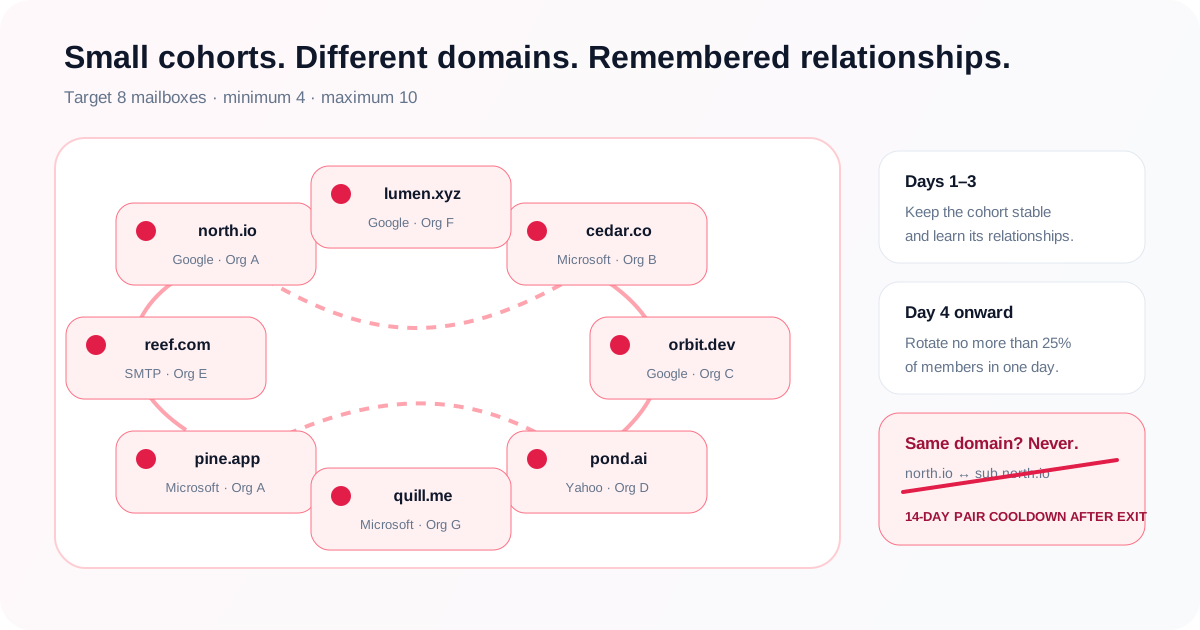
Relationship memory prevents a small circle of mailboxes from repeating the same traffic indefinitely.
3. Replies are short conversations, not endless loops
A reply can show that a mailbox can send and receive a coherent thread. Endless reciprocal replies between the same accounts show only that an automation can loop.
Norbelys bounds conversation length, limits new openers between the same pair, and rotates relationships gradually. Users can choose English or Spanish, guide conversation topics, set a desired reply rate, and provide their own templates. Links are rejected from warmup templates.
Warmup also ignores a campaign’s Reply-To. Replies return to the mailbox in
the From address, so campaign-only routing cannot leak into a warmup thread.
4. Campaigns reserve the mailbox capacity first
Mailbox providers see one sender, not separate “campaign” and “warmup” allowances. Norbelys therefore uses one mailbox-wide capacity decision.
Due campaign work reserves capacity first. Warmup can use only what remains and must still respect sender health and minimum spacing. Immediately before delivery, Norbelys checks that both mailboxes are still active, still belong to the expected group, still use different domains, and have not already claimed the same activity.
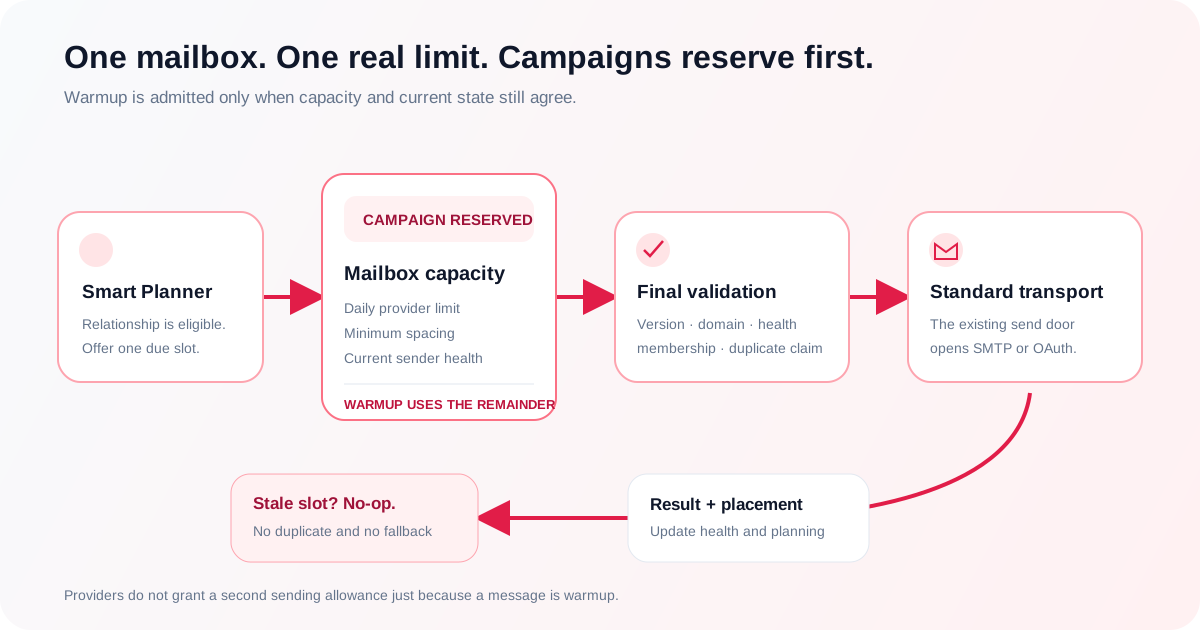
A plan is an offer, not permission to send. Current mailbox state makes the final decision.
This is why “warmup does not use your campaign limit” is the wrong promise. It sounds generous, but the provider still sees the combined total. The honest promise is that campaigns reserve first and warmup fits into the safe remainder.
What can an imperfect first week look like?
A protected ramp often sends less than the configured target. That is a sign that the controls are working, not necessarily a failure.
The table below is an illustrative operating scenario based on Norbelys safety rules. It is not customer performance data and does not imply an inbox-placement result.
| Day | Base target | Safe sends | Why it changed |
|---|---|---|---|
| Day 1 | 5 | 4 | Only four healthy, different-domain peers were eligible. |
| Day 3 | 9 | 7 | Due campaign work reserved part of the mailbox capacity. |
| Day 5 | 13 | 6 | Provider deferrals triggered a temporary health backoff. |
| Day 7 | 17 | 8 | The sender was healthy, but conversation and peer availability limited new work. |
Day 1
- Target
- 5
- Safe sends
- 4
Only four healthy, different-domain peers were eligible.
Day 3
- Target
- 9
- Safe sends
- 7
Due campaign work reserved part of the mailbox capacity.
Day 5
- Target
- 13
- Safe sends
- 6
Provider deferrals triggered a temporary health backoff.
Day 7
- Target
- 17
- Safe sends
- 8
The sender was healthy, but conversation and peer availability limited new work.
The configured ramp did not become an order to send 17 messages. Peer safety, campaign capacity, and current provider feedback reduced the actual volume.
When is a mailbox ready for a real campaign?
Use two weeks as a minimum observation period for a new, low-volume mailbox—not as an automatic launch date. A new domain, damaged reputation, or materially higher target can require longer. Microsoft’s high-volume guidance uses four to eight weeks because the scale is different.
Before adding meaningful campaign volume, confirm:
- SPF, DKIM, and DMARC pass and align;
- activity has been gradual and stable long enough to observe;
- recent placement has enough samples and is not deteriorating;
- hard bounces, deferrals, authentication errors, and spam observations are not rising;
- the prospect list is verified, tightly targeted, and easy to opt out from;
- the campaign fits the mailbox’s real limit without creating a sudden spike.
A 90% warmup inbox reading does not imply 90% campaign placement. Warmup peers are not your prospects. Campaign copy, links, recipient history, complaints, and provider policy still apply.
How should you compare warmup products?
Start with controls, not network-size claims. Public documentation shows that Instantly, Smartlead, lemwarm, and MailReach all provide meaningful warmup features such as automated ramps, replies, provider pools, and deliverability controls. The meaningful difference is how peer history, same-domain protection, and campaign capacity work together.
For broader product, workflow, and pricing context, read the dedicated Norbelys vs. Instantly, Norbelys vs. Smartlead, and Norbelys vs. Lemlist comparisons.
The useful evaluation questions are:
- Can two mailboxes on the same registrable domain exchange messages?
- Does matching remember pair and domain history or redraw recipients daily?
- Can one automated conversation continue without a clear limit?
- Do campaigns and warmup share one sender-level capacity decision?
- Is current sender state checked again immediately before delivery?
- What happens to queued warmup work after a sender is removed?
- Can a duplicate job create a duplicate message?
- Does warmup reuse a campaign-only
Reply-Toor expose a visible marker?
These questions do not assume competitors “do nothing.” They make each vendor explain the controls behind its health score.
Technical deep diveHow Norbelys prevents stale and duplicate warmup sendsShow detailsHide details
The warmup planner does not hold mailbox credentials or open provider connections. It reads a credential-free operational view of eligible senders and offers due work to the same sender coordinator used by the outbound system. The standard delivery pipeline remains the only path to SMTP or OAuth transport.
Sender changes carry increasing versions. If an older update or queued warmup job arrives after a sender was disabled, removed, or restored, its version no longer matches current membership and the work becomes a no-op. A restored sender starts a new membership rather than reviving old conversations.
Each warmup offer also has one claim identity. Duplicate queue deliveries can reach the consumer, but only one can claim transport. Late delivery results update history without authorizing another message.
If warmup coordination is unavailable, warmup stops safely. Campaign processing remains independent, and no older random planner takes over as a fallback. This is what “fail closed” means in practice.
The honest conclusion
Email warmup is valuable because new and quiet senders need gradual, observable history. It becomes misleading when sold as arbitrary activity, a fixed launch date, or guaranteed placement.
A responsible warmup system should choose safe peers, remember prior relationships, shape volume conservatively, respect real campaign capacity, and stop stale work before it sends. It should then show enough evidence for you to make a launch decision without pretending to control the receiving provider.
That is the Norbelys approach: warmup as part of responsible sending, not a separate counter designed to look reassuring.