Email warmup week one: the ramp, the safety gates, and what the numbers do not prove
Norbelys starts with a base target of 5 and adds 2 per ramp day, but actual warmup volume can be lower. Here is why capacity, cohorts, health, and provider guidance matter more than a perfect chart.
By David Lara, Founder
Founder-reviewed ·How we research and correct articles
Week one of email warmup should be uneventful. The mailbox sends a small amount, receives a small amount, produces no sudden provider errors, and gives you enough early history to decide whether it can continue.
It should not produce a miracle placement chart.
The old version of this article showed a fictional climb from 50 to 148 messages and paired it with an invented 88% to 97% inbox curve. Those numbers were not Norbelys customer data, and the volume was not the Norbelys mailbox default. We removed both. A deliverability article should not turn an illustration into evidence.
Here is the real default planning sequence and, more importantly, every reason the actual send count can be lower.
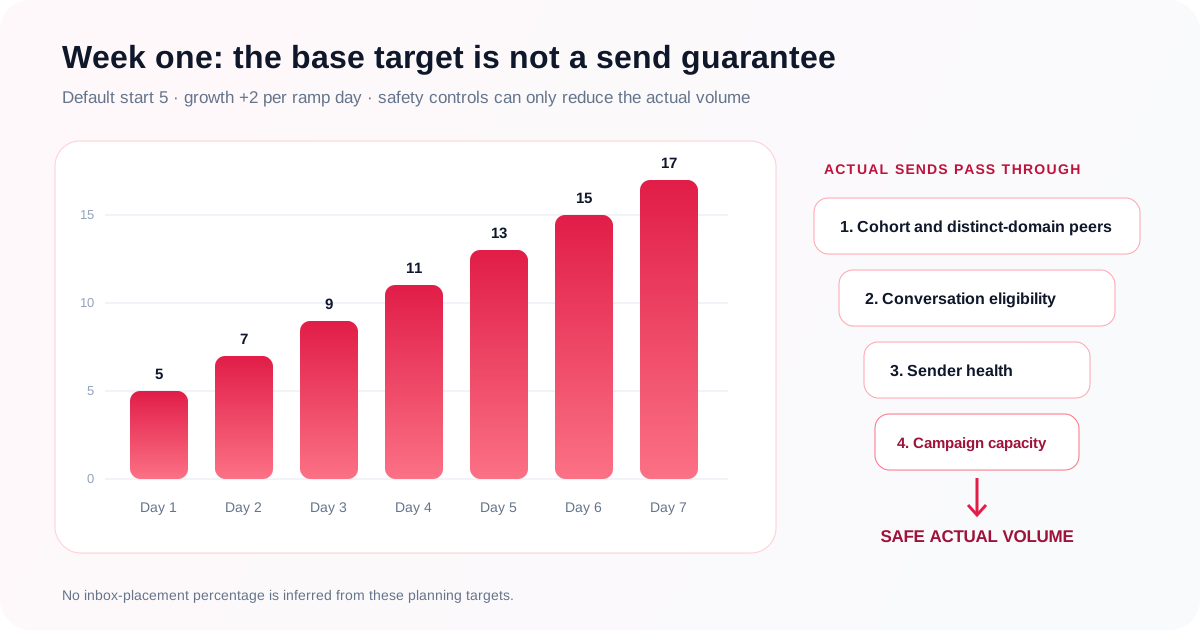
Default base targets before safety controls. They are not promised sends and do not imply an inbox-placement percentage.
The actual Norbelys default
The default warmup settings start with a base target of 5 messages, add 2 per ramp day, and stop increasing at a base ceiling of 40.
| Ramp day | Base target |
|---|---|
| 1 | 5 |
| 2 | 7 |
| 3 | 9 |
| 4 | 11 |
| 5 | 13 |
| 6 | 15 |
| 7 | 17 |
“Base target” is precise language. The planner can reduce the number after it considers the weekday, bounded timing variation, a lighter day, sender health, conversation eligibility, cohort size, and remaining capacity. It cannot use the target to bypass those controls.
That means the actual chart can be flatter than the table. A flatter safe chart is not a failed warmup.
Why a cohort can cap the day below the target
Norbelys builds cohorts of four to ten healthy mailboxes, with eight as the target. Every member uses a different registrable domain.
If your cohort currently has five members, your sender has four possible peers. It cannot invent a fifth distinct relationship merely to satisfy a target of seven. A sender can create at most one opener for a pair in a day, while active threads have their own three-day and three-turn limits.
This is a useful constraint. It prevents the same few mailboxes from cycling through multiple unrelated openers so a dashboard can claim the ramp was hit.
The network can fill an incomplete cohort as healthy, different-domain peers become available. It can also rotate members gradually after three stable days. But it does not trade domain safety for a prettier first week.
Why campaign capacity comes first
A mailbox provider sees the combined stream from your address. It does not grant 40 messages for campaigns and another 40 because a platform labeled them warmup.
Norbelys therefore uses one mailbox-wide limit. Due campaign work reserves capacity first. Warmup uses only what remains after the sender also applies minimum spacing and current health.
Suppose a mailbox has 30 safe sends available today and 24 due campaign messages. Warmup does not claim a separate 17-message allowance just because the base ramp says day seven. At most six remain before other gates.
This is the opposite of a product gimmick: the warmup graph becomes less impressive, but the provider-level volume stays truthful.
Why “increase by exactly 20%” is not a provider rule
You will see articles claim one hard universal formula: increase by 20% every day, or double every three days, or start at exactly 50. The providers do not publish one schedule that fits every sender.
Google’s guidance says the larger the volume, the more slowly it should increase. It recommends daily rather than intermittent sending, consistent rates rather than bursts, starting low with engaged recipients, and reducing volume if bounces or deferrals rise.
Microsoft’s domain-warming guidance uses four to eight weeks for high-volume marketing, with engagement cohorts expanded over time. That is appropriate for its scope. It does not mean every single low-volume B2B mailbox needs exactly eight weeks, just as a two-week mailbox minimum does not authorize a high-volume domain launch on day 15.
The correct schedule depends on:
- whether the domain and mailbox are new or already have healthy history;
- the final target volume;
- Gmail, Microsoft, Yahoo, and other recipient mix;
- authentication and infrastructure changes;
- bounce, deferral, complaint, and placement trends;
- whether recipients genuinely want the campaign.
What happens each day in the first week
Days 1–3: establish a stable baseline
The cohort stays stable. The sender starts with small base targets, and the system learns which peers can receive, which providers are represented, and whether short conversations can continue.
Do not judge readiness from three days. There are too few observations, and a clean beginning can still turn into deferrals when the volume grows.
Days 4–5: allow limited rotation
Beginning on day four, at most 25% of cohort members can rotate in one day. The planner uses receive deficit, active conversation continuity, historical exposure, provider and organization diversity, and time-zone compatibility to choose replacements and relationships.
A pair that leaves enters a 14-day cooldown. The system does not immediately reassemble yesterday’s group under a new cohort ID.
Days 6–7: keep observing, do not declare victory
By day seven, the default base target is 17. Actual volume can remain below that. Look for consistent authenticated delivery, enough provider observations, and no worsening health trend.
One week is an early checkpoint. It is not evidence that the address can handle your campaign target, and it is certainly not proof of a future inbox rate.
The final check happens immediately before sending
Warmup planning and warmup delivery are separate decisions. When a slot becomes due, the sender checks capacity and offers it to the existing delivery pipeline. Immediately before transport, Norbelys atomically claims the offer and rechecks:
- sender and peer status;
- distinct registrable domains;
- current cohort membership versions;
- health and remaining capacity;
- whether another queue copy already claimed the offer.
A disabled or deleted sender makes stale work a no-op. A duplicate queue job does not produce a duplicate email. Warmup itself never opens a second SMTP or OAuth connection path.
That final validation is not visible in a ramp calculator, but it is one of the most important warmup controls.
What to watch instead of a perfect ramp line
Use week one to answer operational questions:
- Are SPF, DKIM, and DMARC passing and aligned?
- Are provider responses showing new deferrals or hard failures?
- Is the mailbox remaining connected for both send and inbox access?
- Is placement based on enough observations to interpret?
- Are warmup sends being deferred because campaigns consumed the safe limit?
- Does the cohort have enough different-domain peers?
- Has any health warning correctly reduced the plan?
The answer “warmup sent fewer messages because the campaign reserved capacity” is not a defect. The answer “warmup sent anyway through an old fallback” would be one.
What week one cannot tell you
It cannot prove that:
- your prospect list is valid;
- recipients will find the offer relevant;
- real campaign copy and links will place like warmup copy;
- complaints will remain below provider thresholds;
- a 90% warmup inbox reading means 90% campaign inbox placement;
- day 14 is safe for every target volume.
Warmup peers are controlled participants. Prospects are not. That difference is why a readiness decision needs authentication, recent placement, delivery errors, list quality, complaint risk, and the planned campaign volume together.
A more honest first-week goal
Your goal is not “send 17 on day seven.” It is:
Reach day seven with a connected, authenticated mailbox, a stable history, no preventable domain conflicts, no duplicate sends, and no signal that requires backoff.
Then continue gradually. Use two weeks as a minimum observation period for a new low-volume mailbox, and longer for a new domain or a larger target. Launch only when the signals agree.
For the full system — cohort matching, conversations, campaign-first capacity, sender removal, and how Norbelys differs from other warmup tools — read How email warmup actually works.