RFC 8058 one-click unsubscribe: what it requires and why enforcement tightened in 2026
The exact List-Unsubscribe and List-Unsubscribe-Post headers RFC 8058 requires, why Gmail and Yahoo made them mandatory for bulk senders in 2024, and what changed in enforcement heading into 2026.
By David Lara, Founder
Founder-reviewed ·How we research and correct articles
If a marketing or bulk email you send doesn’t carry a working one-click unsubscribe, Gmail and Yahoo can reject it outright in 2026 — not spam-folder it, reject it. The mechanism behind that button is a nine-year-old IETF standard, RFC 8058, that most senders never read and mostly don’t need to, provided their sending platform implements it correctly. Here’s exactly what it requires, why two of the biggest mailbox providers made it mandatory, and what’s tightened since.
What RFC 8058 actually specifies
RFC 8058, “Signaling One-Click Functionality for List Email Headers,” was published
by the IETF in January 2017, authored by J. Levine and T. Herkula. It extends an
older standard (RFC 2369’s List-Unsubscribe header) with a second header that
tells the receiving mail client it’s safe to unsubscribe the recipient with a
single click, no confirmation page, no login required.
Two headers, both required on the same message:
List-Unsubscribe— must include at least onehttps://URL (amailto:address is optional but recommended as a fallback). This is the endpoint the mail client will contact.List-Unsubscribe-Post— the value must be exactlyList-Unsubscribe=One-Click. No variation. This header is what tells Gmail, Yahoo, or Outlook that they’re allowed to trigger the unsubscribe automatically, without opening a browser tab or showing the recipient anything else.
The mechanism itself is deliberately simple: when a recipient clicks the native
“Unsubscribe” button their mail client renders next to your sender name, the client
sends an HTTPS POST request straight to the URL in your List-Unsubscribe
header, with the body List-Unsubscribe=One-Click. Your server receives that POST,
processes the unsubscribe, and returns a success response. The recipient never
leaves their inbox.
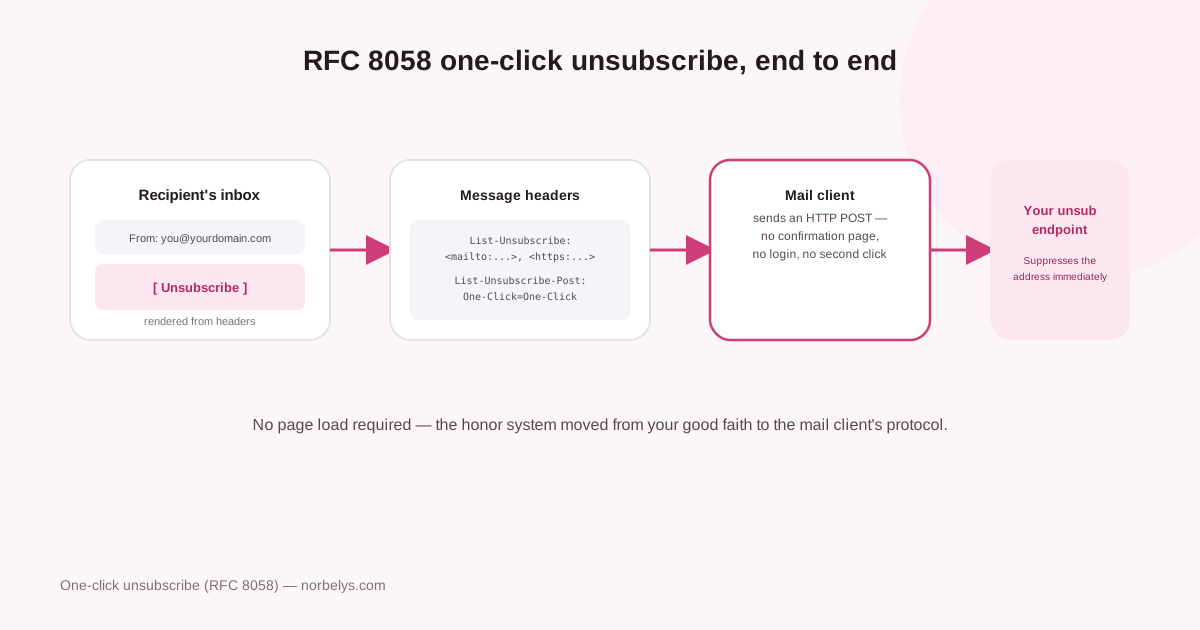
That last part is the detail senders get wrong most often: a footer link to a
“manage preferences” page that then asks the recipient to click a second
“Confirm unsubscribe” button is not RFC 8058 compliant, even if it technically
works. The whole point of the -Post header is removing every step after the
first click. A GET request to a browser-rendered page, however fast, doesn’t
satisfy the spec — the client-to-server exchange has to be the POST described
above, invisible to the recipient.
How this differs from CAN-SPAM’s unsubscribe rule
It’s worth being precise about which rule is which, because they’re often conflated and they set genuinely different bars. CAN-SPAM — the US federal law governing commercial email, covered in full here — requires a working unsubscribe mechanism and gives senders up to 10 business days to honor a request. That’s a legal floor, and it predates RFC 8058 by well over a decade. Gmail’s and Yahoo’s bulk-sender requirements sit on top of that floor, not in place of it: they require the specific RFC 8058 mechanism (not just “any working unsubscribe link”) and cut the honor window from 10 business days down to 48 hours. A sender can be fully CAN-SPAM compliant — a working link, honored within the legal window — and still get bulk mail rejected by Gmail for not implementing the one-click header mechanism at all. The two requirements are compatible, but meeting the lower legal bar alone no longer keeps mail landing in 2026.
Why Gmail and Yahoo made this mandatory
RFC 8058 sat as an optional best practice for seven years. That changed on October 3, 2023, when Google announced new requirements for bulk senders — anyone sending 5,000 or more messages a day to Gmail addresses — phased in by February 2024. Yahoo announced equivalent requirements on the same timeline. Three conditions, all now enforced together:
- Authenticate your mail. SPF and DKIM passing, with DMARC published and
aligned to your
From:domain. The full mechanics of each record are covered here. - Offer one-click unsubscribe on every commercial message, using the exact RFC 8058 mechanism above — not a link, not a preference center with a confirmation step.
- Honor unsubscribe requests within 48 hours. The clock starts at the POST request, not at whenever your team next reviews a suppression list.
- Keep spam complaints under a hard ceiling — 0.3%, with 0.1% as the stated target.
The logic connecting requirement 2 to requirement 4 is direct, and it’s why Google bundled them together rather than treating unsubscribe as a courtesy feature: a recipient who can unsubscribe in one click, instantly, has no reason to click “Report spam” instead. A recipient stuck on a five-field “tell us why you’re leaving” form does. Every complaint against your domain counts against the 0.3% ceiling that gets you rejected outright; every clean, instant unsubscribe doesn’t. One-click unsubscribe isn’t primarily a user-experience nicety — it’s the pressure valve that keeps your spam-complaint rate from blowing past the threshold that determines whether Gmail accepts your mail at all.
What tightened heading into 2026
The requirements above haven’t changed since February 2024. What changed, starting in November 2025, is what happens when a sender doesn’t meet them. Earlier enforcement mostly meant spam-foldering: your mail still arrived, technically, just somewhere the recipient rarely checked. Trade-press coverage of Gmail’s November 2025 update describes a harder mechanism — temporary (4xx) and permanent (5xx) SMTP rejections for bulk senders that fail authentication or exceed the spam-complaint ceiling, meaning the message bounces back to the sending server outright instead of disappearing quietly.
That distinction is operationally important. A rejected message shows up
immediately in your own send logs as a failure; a spam-foldered one doesn’t show up
as anything unusual at all, which is exactly why so many senders didn’t notice they
were out of compliance until it started costing them delivered mail. If your
platform isn’t attaching a compliant List-Unsubscribe-Post header automatically on
every applicable send, 2026’s enforcement is the year that stops being a theoretical
risk and starts being a visible one.
The mistakes that quietly fail compliance
Most senders who fail this requirement don’t fail it obviously — the header is present, something happens when it’s clicked, and it looks compliant on a quick glance. The failures that actually cost deliverability tend to be subtler:
- A
List-Unsubscribe-Postheader with the wrong value. It has to be exactlyList-Unsubscribe=One-Click— a close variant, or the header present but empty, doesn’t count, and a mail client that doesn’t recognize an exact match will either fall back to a slower flow or ignore the header entirely. - A
List-UnsubscribeURL that requires authentication. The recipient’s mail client, not the recipient’s browser, is making the request — if the endpoint expects a logged-in session or a CAPTCHA, the automated POST fails silently and the recipient stays subscribed, which is worse for your complaint rate than having no unsubscribe mechanism visible at all. - An endpoint that only accepts GET. This is the single most common implementation gap: a link that works fine when a human clicks it in a browser, but 404s or errors on the POST request a compliant mail client actually sends, because the server-side route was only ever built and tested for GET. If you’re not certain which requests your own sends carry, pull a raw header set apart with a free analyzer and check both List-Unsubscribe headers by hand.
- Suppression that updates the list but not the send queue. Honoring the request within 48 hours means the next scheduled send to that address has to respect the suppression — a common failure mode is updating a central contact record while a campaign already queued for delivery ignores it.
Any one of these looks fine in a manual test where a person clicks the link in their own browser and watches a confirmation appear — which is exactly why they survive in production for months before a mailbox provider’s compliance check (or a rising spam-complaint rate) surfaces the gap.
The compliance checklist
-
List-Unsubscribeheader present, with at least onehttps://URL -
List-Unsubscribe-Postheader present, value exactlyList-Unsubscribe=One-Click - The URL’s endpoint handles POST requests and returns success without requiring login, a captcha, or a confirmation click
- Unsubscribe requests are processed and suppressed within 48 hours, automatically
- SPF, DKIM, and DMARC are all passing and aligned — check your domain in one pass
- Spam-complaint rate is monitored continuously, not spot-checked monthly
One-click unsubscribe is a small piece of technical plumbing with an outsized effect on deliverability, precisely because it sits upstream of the metric — spam-complaint rate — that mailbox providers now treat as a hard gate rather than a soft signal. It’s also one part of a broader compliance picture that includes the US anti-spam law your sending has to respect in the first place, and staying ahead of it is considerably cheaper than recovering domain reputation after Gmail starts rejecting your mail outright.