Cold email first lines: the opener is the real subject line
Gmail and Outlook show your first line in the preview pane before anyone opens anything. How to write proof-of-homework openers — with six rewrites of the lines everyone sends and a test for whether yours passes.
By David Lara, Founder
Founder-reviewed ·How we research and correct articles
Your subject line gets 3–5 words of attention. Your first line gets the next 15 — rendered right in the inbox preview, before any “open” happens. Which means the sentence most people spend zero minutes on (“Hi, I hope this email finds you well, my name is…”) is actually the second-highest-leverage line in the entire email.
The one test a first line must pass
Cover your product name and read the opener. Could this exact sentence be sent to 500 other people? If yes, it’s not a first line — it’s a merge field wearing a sentence.
The data behind the fuss: Backlinko and Pitchbox’s 12-million-email study associated personalized bodies with ~32.7% more responses. Woodpecker’s 20M+ platform benchmark reported 17–18% reply rates for advanced personalization against 7–9% for segment-level relevance. The first line is where a reader decides which kind of email this is.
Six rewrites
Each pair below is the line everyone sends, then the line that proves homework. Same prospect, same product.
The introduction
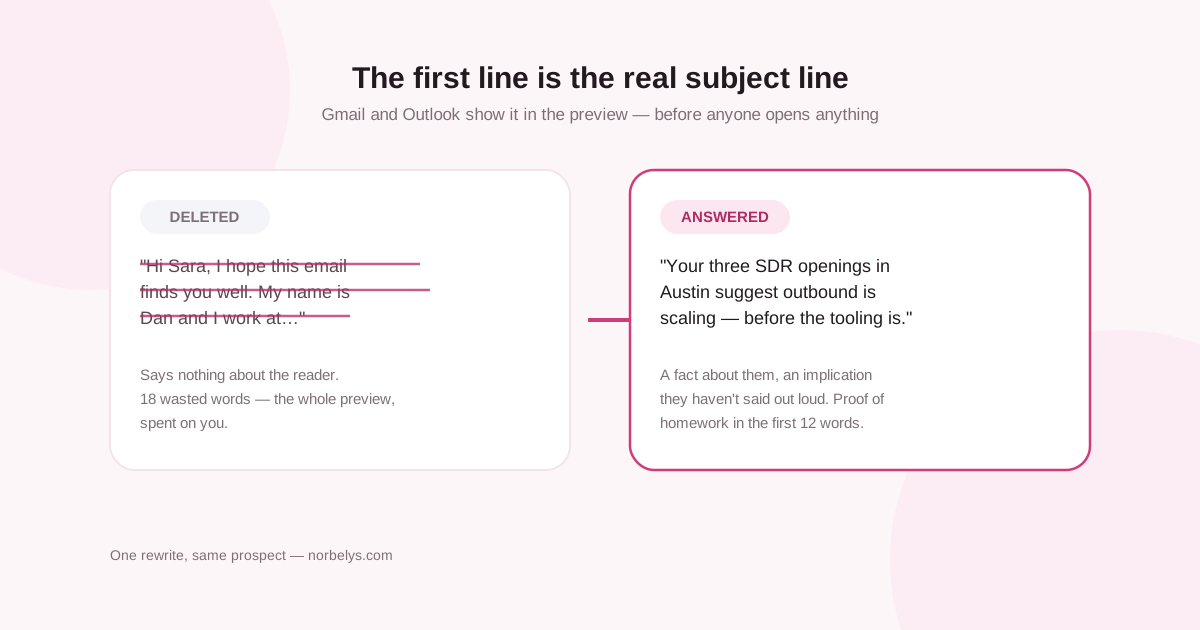
- ✗ “Hi Sara, my name is Dan and I’m a founder at…”
- ✓ “Your three SDR openings in Austin suggest outbound is scaling — before the tooling is.”
Nobody has ever replied to learn your name. The rewrite spends its twelve words on a fact about them plus an implication they haven’t said out loud.
The flattery open
- ✗ “Congrats on the amazing Series B! Truly inspiring journey.”
- ✓ “The Series B post said ‘double the GTM team by Q2’ — that’s usually when reply tracking breaks first.”
Congratulations without a consequence is noise. Tie the news to the problem you solve or don’t mention the news.
The fake-familiar
- ✗ “I’ve been following your work for a while and love what you’re doing.”
- ✓ “Your post on churn-by-cohort — the part about month-3 cliffs — matches what we see in onboarding data.”
If you actually read something, prove it with a specific. If you didn’t, don’t pretend; readers can smell the difference in one clause.
The rhetorical question
- ✗ “What if you could double your reply rate overnight?”
- ✓ “You’re sending from a domain registered in March — that ceiling on your reply rate might not be the copy.”
Questions that answer themselves get deleted by people who read forty pitches a day. An observation with stakes earns the second sentence.
The we-do statement
- ✗ “We’re a leading platform for revenue intelligence.”
- ✓ “Two RevOps leads at companies your size told us the same sentence last month: ‘I don’t trust our dashboard.’”
Category language is invisible. A quoted customer sentence is voice-of-market research the reader can feel.
The apology
- ✗ “Sorry to bother you, I know you’re busy, but…”
- ✓ “This is worth 20 seconds if deliverability is on your desk; delete it if not.”
Apologizing frames the email as an imposition — and the reader agrees. Confidence plus a fast exit respects their time more than the apology does.
Where the homework comes from (in under two minutes)
You don’t need twenty minutes per prospect. You need one specific:
- Hiring pages — open roles reveal initiatives and budgets.
- Their last three posts — one concrete detail beats “love your content.”
- Public numbers — funding, team size, launch dates, pricing changes.
- Their tech, visible from outside — job listings name the stack; email headers name the sending infrastructure.
- The trigger file — if you segment by trigger event, the first line is pre-written by the segment itself.
At volume, this is the exact piece worth automating well: Norbe researches each prospect per send, with cited sources, so the opener is checkable instead of hallucinated.
First line + subject: one continuous thought
The best-performing combination we see treats subject and opener as a single sentence split across two fields:
Subject: the austin hiring spike First line: — three SDR roles in one month usually means the pipeline math changed. Curious if the tooling kept up.
The subject earns the glance, the preview pays it off, and neither wastes words repeating the other. Length data says keep the subject in the 36–50 character pocket and spend the saved characters here, where they compound.
One more honest number: even a perfect opener can’t be measured by opens — roughly half of them are robots. Judge first lines the only way that pays: replies per hundred sends.